Home › Brain trainers › Clock
Clockspatial reasoning puzzle
Assemble a number from sliced halves: pick the paper that folds into the right digits. Trains spatial reasoning.
Play now →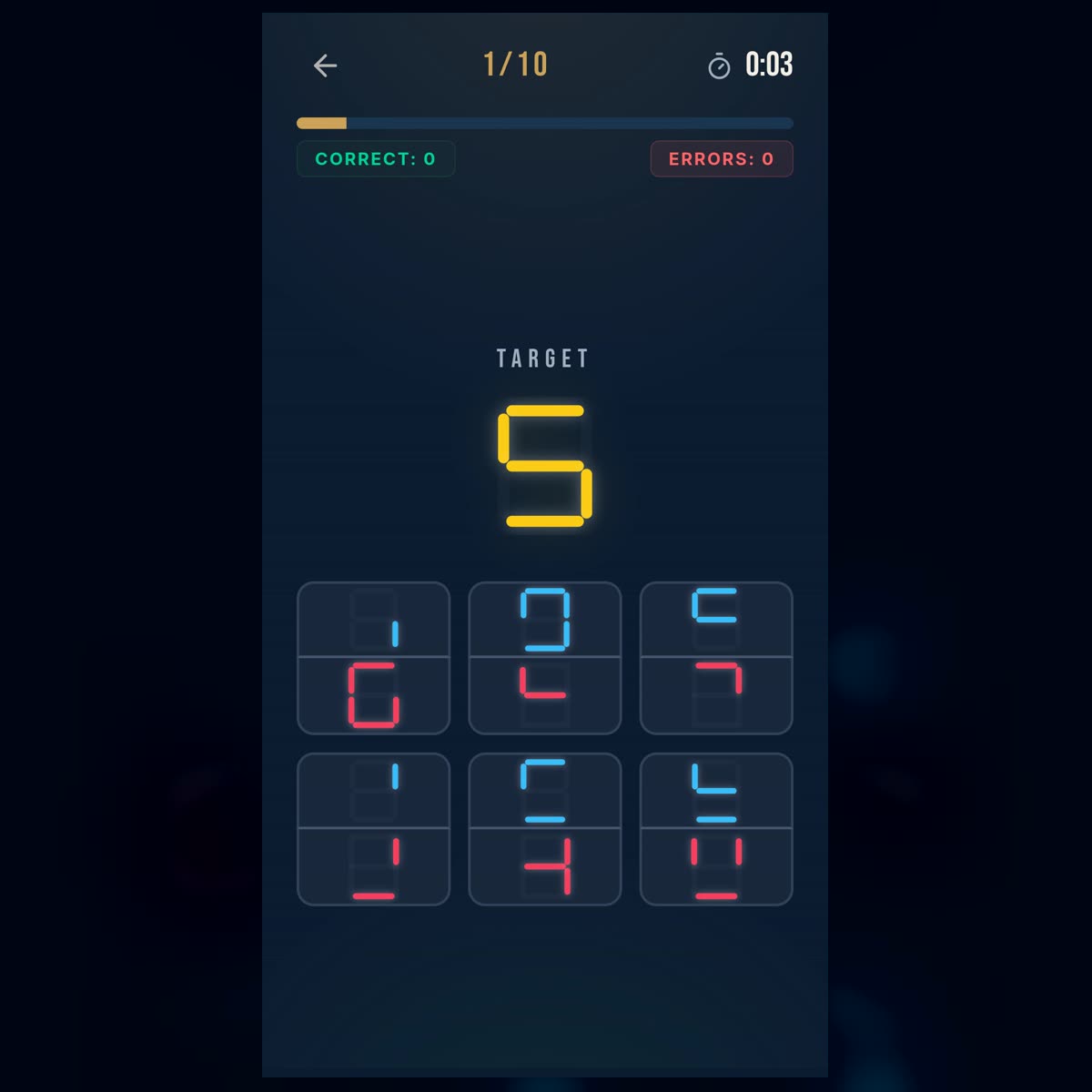
The Clock simulator is a dynamic puzzle that challenges your ability to visualize objects. A target number appears before you, stylized as an electronic display, along with several options of cards cut in half. Your task is to find the single top and bottom parts among the offered halves that, when mentally combined, will form the given digit.
WHAT IT DEVELOPS AND EXACTLY WHY
This mechanic is an excellent tool for training spatial thinking, logic, and cognitive flexibility. From a scientific perspective, the process of mentally combining fragments activates the mechanisms of mental shape manipulation and visuospatial working memory. You don't just look at a picture; you force your brain to hold the shape in your head, rotate its details, and complete the missing elements according to the Gestalt principle. This heavily burdens attention to the small details of the contour, because even one extra or missing segment on a card makes it incorrect. Regular performance of such tasks helps develop the brain's ability to quickly process visual information, which is useful for spatial orientation and solving complex logical problems.
HOW TO PLAY AND STRATEGY
To achieve high results, do not try to chaotically go through all available card options. The most effective strategy is to focus initially only on the top or only on the bottom part of the target digit. Mentally cut off, for example, the top of the target and quickly scan all the blue halves on the screen, weeding out those that definitely do not fit. Only after you have narrowed the choice down to two or three cards, check their red bottom parts for an exact match to the overall contour.
WHO AND WHEN IT IS USEFUL FOR
The simulator is perfectly suited for people who need to improve their concentration of attention and ability to work with visual data in everyday life. This is an excellent brain warm-up before the start of the workday or during a break to quickly regain focus, tune in to productive work, and activate spatial thinking.