
Home › Brain trainers › LIMO
LIMOtwo-player abstract strategy game
A duel of two-sided tiles on a 7×7 board: force your opponent's color into lines and squares. Play vs computer or with a friend.
Play now →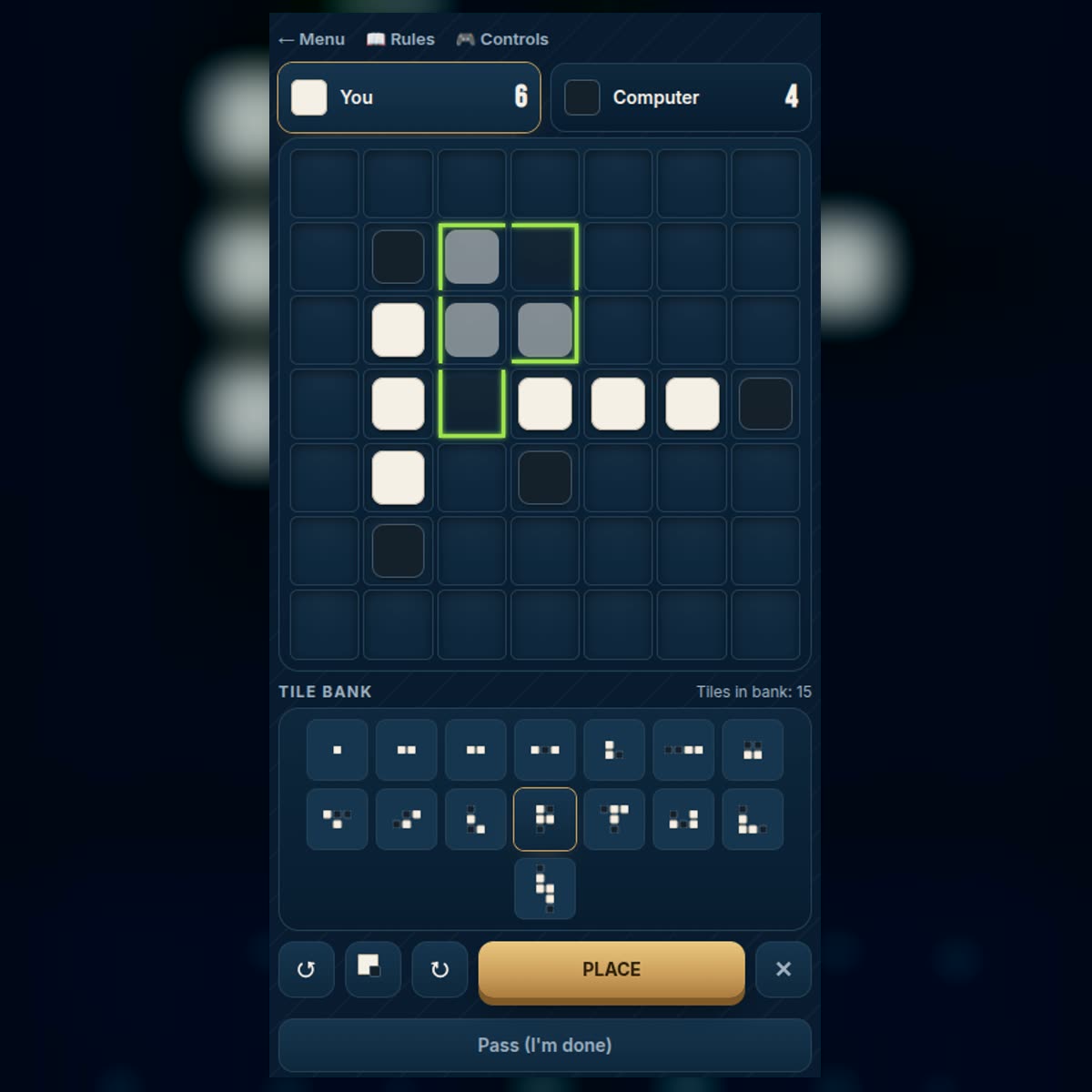
LIMO is an abstract strategy game for two players on a 7×7 board. Players take turns changing the position to form advantageous combinations of colors: straight lines and squares. It can be played against the computer, with two players on one device, or online.
The special feature of LIMO is that the pieces are not divided into separate sets for the two sides. They are universal, and each player is represented by a specific color. Therefore, it is important not just to occupy cells, but to monitor how each move changes the color balance in different parts of the board.
How position works
The 7×7 board is large enough to develop several combinations simultaneously, but compact enough for every move to affect adjacent lines and squares. A single piece can participate in several potential formations at once.
Because of this, a locally useful move does not always improve the overall position. By completing one line, a player might open up an opportunity for the opponent to create a square or capture control over an important area.
Cells that can complete multiple combinations simultaneously are especially valuable. Controlling such points allows you to create double threats, where the opponent cannot stop all options with a single move.
Planning and reading threats
In LIMO, it is not enough to see only your own nearest combination. Before each move, it is worth checking which lines and squares the opponent can complete.
It is useful to evaluate the position in three stages:
is there an immediate threat from the opponent;
what combination of your own can be prepared;
how will the board change after the opponent's strongest reply.
Strong moves often serve two functions simultaneously: blocking an enemy formation and creating your own. Simply closing a threat without a further plan can give the opponent the initiative.
It is also important not to become attached to one section of the board. If the opponent has reliably blocked your chosen direction, it is better to shift activity to another part of the board than to continue a predictable attack.
Practical strategies
At the beginning of the game, try to create shapes that have multiple possible continuations. Placing colors with potential for both a line and a square is harder to block.
Do not rush to complete an obvious combination if you can prepare a second threat first. Double pressure is often more effective than an immediate result.
Check not only horizontal and vertical connections. During a dense position, it is easy to overlook a square forming slightly away from the main struggle.
Monitor the color balance in different areas of the board. If the opponent gains an advantage in one sector, you do not always need to fight right there. Another part of the board may offer more space for your own plan.
Before making a move, imagine that you are now playing for your opponent. Which response would be the most unpleasant for you? Such a quick check helps you notice traps in time.
What makes LIMO engaging
The game requires positional thinking, as the value of a move is determined not by an individual piece, but by its connections with the entire structure of the board. The player analyzes already formed combinations and predicts which ones might emerge later.
Planning ahead is necessary to create multi-move threats. A direct attack is often easily blocked, so it is more advantageous to prepare several possible continuations.
Attention is engaged due to the need to simultaneously track lines, squares, and opponent actions in different parts of the board. The more complex the position becomes, the more important it is to regularly scan the entire board, not just the location of the last move.
Cognitive flexibility manifests in changing strategy. If the initial plan stops working, the player needs to switch from attack to defense, move the struggle to another area, or use colors in a new combination.
Who might be interested in the game
LIMO is suitable for fans of abstract games with simple rules and a gradual increase in strategic complexity. It does not require knowledge of complex openings or a large number of exceptions, but rewards careful position reading.
Playing against the computer is convenient for solo practice, while two-player mode is great for competing with a live opponent and adapting to their style. One player might build direct and obvious threats, while the other acts through slow control of key cells.
LIMO can be used as a short mental warm-up that shifts attention from passive information reception to active analysis and choosing between several options.
Lines and squares in abstract games
Building geometric combinations is one of the oldest principles of positional games. In tic-tac-toe, you need to complete a line, while in many modern abstract strategies, territories, enclosed areas, and shapes of various forms are added to lines.
LIMO combines two clear geometric concepts — the line and the square. They require different methods of planning. A line develops in one direction, whereas a square forces you to monitor several cells at once and the relative positioning of corners.
It is the combination of these goals that creates a variety of positions. A move that stops a line can help form a square, and defending one part of the board can weaken another. Therefore, in LIMO, it is important not just to find an available combination, but to control what opportunities each move leaves for both players.