
Home › Brain trainers › Who's the Killer?
Who's the Killer?logic and deduction game
One suspect is the killer — and the killer always lies. Ask questions, cross-check the answers and deduce who it is. Trains logic and deduction.
Play now →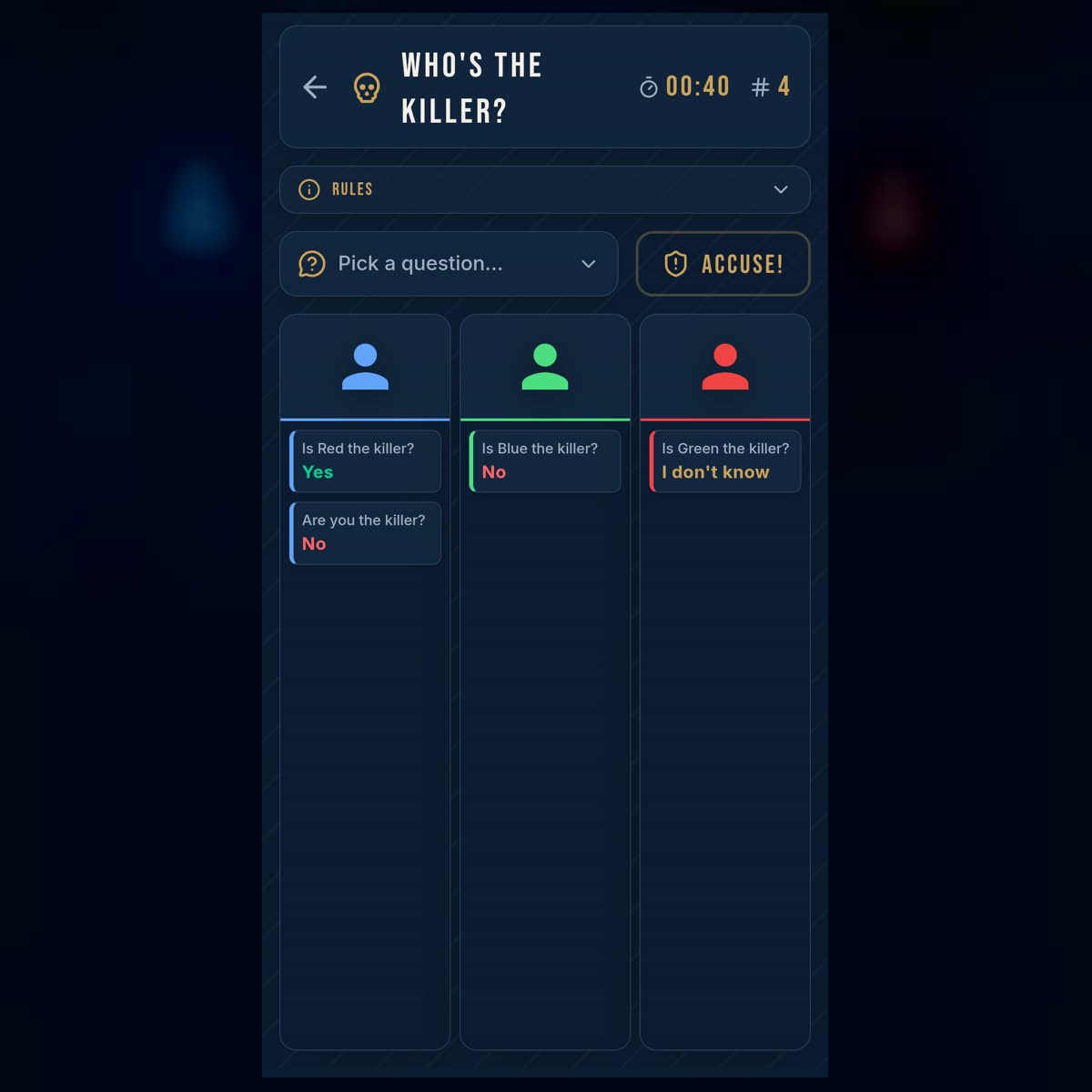
The "Who is the Killer" simulator is a detective puzzle that will allow you to feel like a real investigator. Before you is a group of suspects, among whom the criminal is masterfully hiding. The main feature of the mechanics is that the real killer always lies. Other characters have their own roles: someone is an absolute truth-teller, someone is a regular liar, and someone is a "doubtful" witness. Your task is to ask them questions, compare the obtained testimonies, and use deduction to figure out the guilty party in order to bring formal charges.
WHAT IT DEVELOPS AND WHY EXACTLY
This simulator is an ideal tool for honing problem-solving skills, logic, and cognitive flexibility. The game's mechanics rely heavily on the famous class of paradoxes about knights and knaves, which were actively studied by prominent mathematicians and logicians, such as Raymond Smullyan. By completing this task, your brain learns to operate with the algorithms of Boolean algebra and formal logic, building chains of reasoning from contradictions. You have to simultaneously keep several mutually exclusive hypotheses in your working memory and systematically test them. This is not intuitive guessing, but strict deduction. In addition, such an activity requires extreme attention to the details of each answer, because a single word can become the key to destroying a false alibi.
HOW TO PLAY AND STRATEGY
The main rule of a successful investigation is not to jump to conclusions after the very first question. The best strategy is to formulate queries that are guaranteed to provoke logical conflicts and provide maximum cross-information. Try to ask the suspects about each other. If one character claims that the second is telling the truth, and the second openly accuses the first of lying — you have just caught them in a logical trap and can confidently discard impossible combinations of roles. Carefully look for such mutually exclusive testimonies to narrow the search circle.
WHO IT IS USEFUL FOR AND WHEN
This game is perfectly suited for lawyers, programmers, analysts, and anyone whose profession requires critical thinking and the search for truth in complex data sets. Regular training will help you learn to quickly recognize logical inconsistencies in information, build flawless argumentation, and systematically approach the solution of any life or work problems.