
Home › Brain trainers › Missing Numbers
Missing Numbersnumber logic puzzle
Place the plaques so every row and column sum matches its target. Trains logic, speed and combinatorial thinking.
Play now →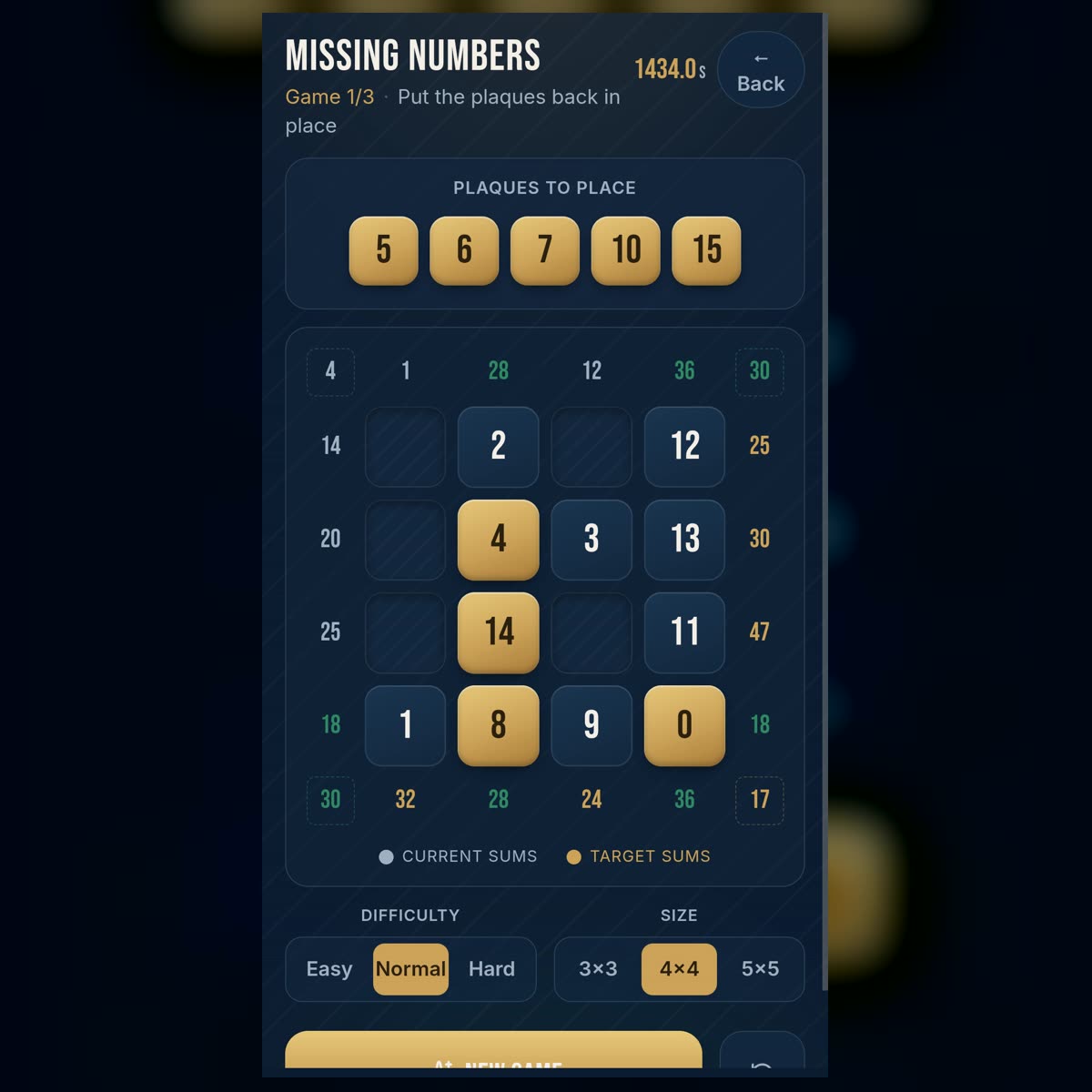
How to play
Some numbers have fallen out of the matrix — help put them back. The numbers around the matrix guide you: the gold ones show the sum each row, column and diagonal must add up to, and the white ones show the sum reached so far. Drag the plaques from the reserve onto the empty cells; when the white numbers meet the gold ones, the board is complete.
In the "Missing Numbers" trainer, a number matrix with some missing tiles is presented to the player. The lost numbers must be returned to the board so that the sums in each row, column, and diagonal match the target values.
Yellow numbers indicate the target sum to be reached. White numbers show the current result from moves already made. This allows the player to instantly see how close a row or column is to the correct answer.
At first glance, the task resembles a simple addition exercise. However, the main difficulty lies not in the calculation itself. One must determine which number to place in each empty cell while considering multiple constraints simultaneously. A number might perfectly complete a row, but at the same time make it impossible to properly complete a column. Therefore, every move must be evaluated not in isolation, but as part of the entire system.
What the "Missing Numbers" Trainer Develops
The most obvious strain falls on mental arithmetic. The player continuously adds numbers, compares the current sum to the target sum, and determines the difference between them. For instance, if a row must equal 24 and the already placed numbers sum to 17, one needs to find a tile with a value of 7 or determine a combination of several numbers that together equal this difference.
However, the trainer develops more than just calculation speed. It is also a problem of logical thinking and combinatorial search. One must consider various number placement options, eliminate impossible combinations, and gradually narrow down choices.
In mathematical tasks, working memory helps temporarily hold intermediate results, perform operations on numbers, and keep track of several solution steps. Research shows a steady link between working memory and arithmetic skills, though the strength of this link depends on age, task complexity, and chosen strategy.
In "Missing Numbers," one must remember which tiles have already been used, which remain, how much is missing in different lines, and how a potential move will affect multiple sums at once. This creates a significantly higher cognitive load than a standalone addition problem.
The trainer also fosters cognitive flexibility. If the first layout version does not work, one must step back, re-evaluate assumptions, and try another combination. It is crucial not to cling to the first number that seems suitable, but to verify whether it aligns with all cross-referencing constraints.
How "Missing Numbers" Differs from Standard Mental Arithmetic
In a traditional arithmetic problem, there is usually a single sequence of steps and one answer. For example, simply calculating the sum of several numbers. In a matrix, the situation is different: the answer for a single cell depends on its entire surrounding environment.
Every empty cell is located at the intersection of a row and a column. If it belongs to a main or secondary diagonal, three conditions may act upon it simultaneously. It is precisely the intersection of constraints that often allows finding the correct number without guessing through all options.
For instance, a row might lack 8, while a column lacks 5. This does not mean the cell must contain an 8 or a 5: there might be other empty spaces in each of those lines. However, such information already helps clarify which numbers can belong to the needed combinations and which tiles definitely will not fit.
Thus, the puzzle turns into a constraint satisfaction problem. A similar principle is found in Sudoku, magic squares, logic grids, scheduling problems, and many algorithmic challenges. A correct solution must fulfill the entire system of rules simultaneously, rather than a single local condition.
Start with the Line Having the Fewest Unknowns
The most effective basic strategy is not to start with the first empty cell. First, examine the whole matrix and find the row, column, or diagonal with the fewest missing tiles.
If only one empty space remains in a line, its number can be determined immediately. One simply subtracts the sum of all placed numbers from the target sum.
For example, the target sum of a row is 31. The numbers 6, 9, and 11 are already placed, leaving one empty cell. The sum of the known numbers is 26; therefore, the empty cell must contain 5.
Once this number is placed, the corresponding column—and possibly a diagonal—changes. They might also be left with only one unknown. In this way, a single reliable move triggers a chain of subsequent deductions.
This principle can be called moving from the most constrained part of the problem. The fewer permissible options a given line has, the easier it is to draw a reliable conclusion.
Rely on the Difference Between Target and Current Sums
Instead of adding up the entire row from scratch every time, focus on how much it lacks. The difference between the yellow and white numbers shows the sum of all empty cells in the corresponding line.
For example, the target value is 40, and the current sum is 27. Therefore, the empty cells in this row must sum to 13.
Now look at the available tiles. If numbers 2, 4, 5, 7, and 9 are available, and two empty cells remain in the row, possible pairs could be 4 and 9, or another combination summing to 13. The pair 5 and 7 is invalid because its sum is 12.
However, do not place 4 and 9 immediately. First, check the columns where these numbers would fall. Perhaps one of the columns cannot accept a 9, automatically determining the placement of the tiles.
The difference between the target and current sum is one of the most vital guides in the game. It breaks a large matrix down into a series of smaller problems: finding a single number or a combination of numbers with the required sum.
Use the Intersection of Two Conditions
If you cannot determine a number precisely using a single row, check the corresponding column. The cell must satisfy both conditions simultaneously.
Suppose a row has two empty cells remaining that must total 12 together. Among available numbers, pairs like 3 and 9, or 5 and 7, fit. The row alone does not allow choosing the correct pair.
Now look at the column of the first empty cell. If it lacks exactly 5, then the first cell must contain 5, and the second must contain 7. Other combinations are automatically eliminated.
This is why considering rows in isolation from columns is risky. The most valuable information often emerges at their intersection. Diagonals add another layer of verification and can help resolve cells that remained ambiguous.
Do Not Guess Tiles Randomly
Randomly shuffling numbers may occasionally lead to the correct answer, but it barely helps in understanding the logic of the puzzle. Furthermore, as the board size grows, the number of possible permutations increases rapidly.
With four distinct tiles, they can be arranged in 24 ways. For six tiles, the number of permutations skyrockets to 720. Manually testing all options is inefficient.
Instead of exhaustive search, use constraints to eliminate whole groups of options. If two cells must total 10 together, all pairs with a different sum can be ignored. If a column lacks only 3, a 7 cannot go into its last cell. Every such conclusion reduces the search space.
Combinatorial thinking is not about imagining absolutely every permutation. It is far more important to learn how to prune them using rules.
Make Temporary Assumptions Cautiously
In a complex matrix, a point may be reached where no number can be determined with certainty. In such cases, an educated guess can be made, but it must be clearly distinguished from a proven move.
For example, in a certain row, only two pairs are possible: 2 and 8, or 4 and 6. One can temporarily test the first option and observe where it leads in the columns and diagonals.
If a contradiction arises—such as another line requiring a number no longer present among available tiles—the assumption was incorrect. One must backtrack and test the second option.
This method is called backtracking. It is useful, but best applied only after direct logical conclusions have been exhausted. Otherwise, it is easy to build a long chain of moves based on a false premise and lose control of the solution.
Break Down Complex Calculations into Simpler Ones
For quick mental math, it is helpful not to always add numbers strictly in the order presented. They can be regrouped into convenient combinations.
For instance, the sum 8 + 7 + 2 + 3 is easier to see as 8 + 2 and 7 + 3. This gives two tens, or 20.
The sum 19 + 6 can be computed as 20 + 5. And the difference between 43 and 28 as 43 − 30 + 2. Such strategies are called decomposition: breaking a more complex operation into several simpler ones.
Research on arithmetic thinking shows that people utilize various ways to reach an answer: direct retrieval, counting, or decomposing the task into convenient parts. The choice of strategy affects working memory load and solution speed.
In "Missing Numbers," it is particularly useful to quickly spot pairs that form 10, 20, or another round number. This frees up mental bandwidth for the logical part of the task—checking where the tiles need to go.
Keep Track of Used Numbers
Even a correct calculation can lead to an error if one forgets that a required tile has already been placed elsewhere. Therefore, the set of available numbers is just as important a constraint as the row and column sums.
After every move, check not only the new current sums, but also which numbers remain. Sometimes the remaining pool directly hints at the solution. If two cells require a sum of 14, and the unused tiles only include 5 and 9, their set is already determined.
Attentiveness to the remaining pool also helps detect errors. If a number is left over at the end that cannot fit into any cell without exceeding a target sum, it is highly likely that one of the previous tiles was placed incorrectly.
Check More Than Just Completed Lines
After each move, it is beneficial to quickly scan all lines affected by the new tile. Do not wait until a row or column is completely filled.
If the current sum has already exceeded the target, the mistake is obvious. But even without an overshoot, an extra check can be performed. See whether the remaining numbers can physically yield the required difference.
For example, a column lacks 4, but the smallest available tile is 6. This means the current arrangement is already impossible, even though the target sum is formally not yet exceeded.
Such early checks allow catching contradictions before they propagate across the entire matrix.
Speed Follows Proper Strategy
The trainer may demand quick decisions, but initially, it is more important to learn to see the structure of the puzzle. Without a systematic strategy, rushing often leads only to a higher number of random rearrangements.
First, accustom yourself to executing the same sequence of actions:
examine the entire matrix;
find the line with the fewest empty cells;
calculate the difference between target and current sums;
check available tiles;
cross-reference conditions for rows, columns, and diagonals;
verify after a move whether a contradiction has arisen.
When this algorithm becomes second nature, decisions speed up naturally. The player spends less time on chaotic searching and faster identifies the most informative parts of the board.
Who Benefits from "Missing Numbers"
The trainer is suitable for people who enjoy number puzzles, Sudoku, logic grids, magic squares, and combinatorial tasks. Playing does not require higher mathematics: basic addition and subtraction are sufficient. The challenge arises from the interdependence of conditions rather than complex formulas.
"Missing Numbers" can serve as a useful mental warm-up before studying or working. The task simultaneously engages calculation, attention, working memory, and multi-step planning.
Regular practice helps execute these specific numerical tasks faster, spot convenient combinations, and apply a more organized strategy. However, the trainer is not a clinical test of mathematical ability, nor does it guarantee general improvements in memory or intelligence. Cognitive training research reviews caution that progress in a specific exercise does not always transfer broadly to distant, unrelated skills.
The most valuable aspect of this game is not merely placing all numbers correctly, but understanding how each conclusion stems from constraints. Upon completing a level, it is helpful to mentally reconstruct the path to the solution: which line gave the first clue, where the intersection of conditions worked, and which option was eliminated thanks to the remaining tiles.
When the player stops seeing the matrix as a collection of separate arithmetic exercises and begins perceiving it as a single logical system, "Missing Numbers" becomes vastly more engaging. It is precisely in this combination of simple calculation and multi-step deduction that the primary feature of the trainer lies.