Home › Brain trainers › Rotate Cube
Rotate Cubemental rotation puzzle
A cube is shown from one angle. Pick the option that is the same cube, just rotated. Trains spatial reasoning and mental rotation.
Play now →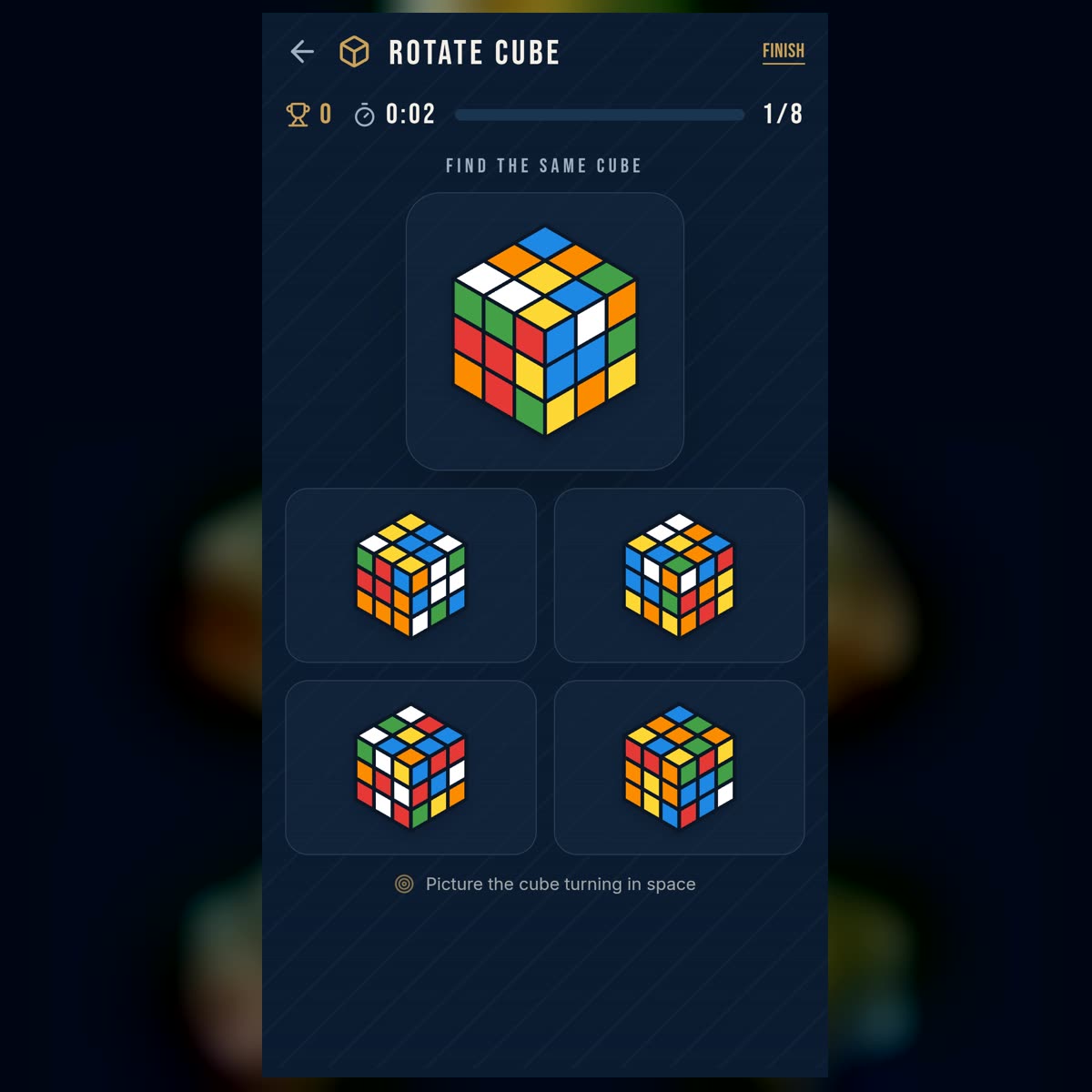
In the "Spatial Cube" trainer, you need to recognize the same cube shown from a different angle. Initially, you see a cube with symbols, colors, or other markings on its visible faces. Then, among several options, you must find the image that can be obtained by rotating the original cube in space.
The task seems simple only as long as the options differ in obvious details. At more complex levels, almost all cubes may look plausible. One has the correct symbols, but they are arranged in the wrong order. Another retains two adjacent faces, yet the third turns out to be on an impossible side. To find the correct answer, it is not enough to memorize a single drawing — you need to understand the spatial structure of the entire object.
This mental operation is called mental rotation. A person creates an internal image of an object and mentally turns it as if holding a physical cube in their hands. Mental rotation became one of the most famous subjects of cognitive psychology research following an experiment by Roger Shepard and Jacqueline Metzler, published in 1971. Participants compared three-dimensional figures and determined whether they were identical after a rotation. Response time increased along with the angle by which the object had to be mentally rotated. This became an argument in favor of the fact that people actually perform a kind of internal rotation of the image, rather than just comparing individual features.
What Mental Cube Rotation Develops
The main load in this trainer falls on spatial thinking — the ability to imagine the shape, position, and relative arrangement of parts of an object. You see only a few faces, but you must reason about the cube as an integral three-dimensional structure.
During the task, visuospatial working memory operates. It is necessary to retain the location of symbols on the initial cube, transfer it to a new orientation, and compare the result with the options. The more similar markings and the more complex the rotation, the harder it is to maintain an accurate internal model.
The trainer also develops attention to spatial relations. The most important thing here is not which face is located at the top of the image, because after a rotation, the top easily becomes a side. It is important which faces touch each other, in what order they are placed around a common corner, and which surfaces can never end up next to each other.
Spatial skills are needed not only for geometric puzzles. They are used when a person reads a map, assembles an object according to a diagram, parks a car, imagines a room layout, works with a drawing, or tries to understand what a structure will look like from the other side. Spatial thinking plays a particularly noticeable role in engineering, architecture, design, geometry, chemistry, geology, and many technical specialties.
At the same time, one should not conclude that a single online trainer will automatically improve all related abilities. Studies show that exercises can increase performance in mental rotation tasks, but part of the progress is explained by familiarity with the format and mastery of more effective strategies. Transferring the skill to other tasks is possible, but its scale depends on the method and duration of training.
How to Properly Compare Cubes
A common mistake is trying to track only one face. For example, a player sees the same symbol on the front of two cubes and decides they match. But one face proves nothing: there may be completely different neighbors around it.
It is more reliable to find a corner on the initial cube where three prominent faces meet. Remember not only the symbols themselves, but also their order. During normal rotation of the cube, these three faces remain adjacent. They can move up, down, or to the side, but they cannot arbitrarily swap places as if the cube were reflected in a mirror.
For example, let a circle, a triangle, and a star converge near one corner. After rotation, the circle may end up on top, the triangle on the right, and the star in front. This is entirely possible. But if in the option the star ended up on the opposite side of the cube or the order of faces around the corner became mirrored, this is already a different cube.
Another useful guideline is opposite faces. On a regular cube, each face has four neighbors and one opposite surface. Opposite faces do not share an edge and will never simultaneously be part of the same visible cube corner. If you were able to determine such a pair, some incorrect answers can be discarded without full mental rotation.
Compare options sequentially. First, check if the correct adjacent faces are preserved. Then look at their order. Only after this analyze the direction of the symbols, if they can be rotated themselves. This approach is more reliable than trying to scroll the entire cube in your head at once.
Rotation or Mirror Reflection
One of the main traps in such tasks is the mirrored variant. It may contain the same symbols and almost the same arrangement, but it cannot be obtained by a normal rotation.
Imagine three different marks on faces that converge near the same corner. If you move around this corner in a certain direction, they have a fixed order. Rotation changes the position of the cube relative to the observer, but does not turn the right order into the left. A mirror reflection, on the contrary, changes this orientation.
This is similar to the right and left palms. They have the same parts, but no rotation of the right hand can turn it into the left. Similarly, a mirrored cube can look very similar to the original while remaining a different spatial configuration.
If two options seem equally correct, check the exact order of the three faces near the common corner. Often one of them is a permissible rotation, and the other is a mirrored trap.
Practical Solution Strategy
First, choose the most recognizable symbol on the initial cube. Find it in the options and see which two faces are located next to it. If the neighbors do not match, the option can be immediately discarded.
Then choose a triplet of faces converging in one corner. Try to mentally fix this corner and rotate the entire cube around it. Do not move each symbol separately: imagine that all three faces are parts of one solid object.
If a full rotation is difficult to imagine, perform it in stages. First, turn the cube a quarter turn left or right. Then, if necessary, tilt it forward or backward. A few simple turns are often easier to control than one complex movement.
Do not rush to move on to the answer just because the overall appearance matches. Before choosing, ask yourself three questions: are the adjacent faces correct, is their order preserved, and is the image not mirrored? If all three checks are passed, the option is most likely correct.
Who Benefits from the "Spatial Cube" Trainer
The trainer is suitable for anyone who wants to practice spatial imagination, attentiveness, and working with three-dimensional objects. It is especially interesting for people who like geometric problems, constructors, blueprints, puzzles, and shape rotation games.
Such exercises can be a useful warm-up before study or work where it is necessary to operate with diagrams, shapes, and spatial models. At the same time, a technical education is not required for training: the ability to mentally rotate is not an immutable talent available only to certain people. Practice helps to better recognize spatial connections, avoid typical mistakes, and apply a more systematic strategy.
The most important indicator of progress is not just the speed of response. Pay attention to whether you can explain your choice: which faces remained adjacent, how exactly the cube rotated, and why other options are impossible. When the answer is based not on a guess, but on a tested spatial model, training becomes much more meaningful.