
Home › Brain trainers › Ternia
Terniathree-in-a-row strategy game
A 3×3 strategy game: be first to line up three identical tokens of your colour. Play the computer or a friend.
Play now →
© Ternia. This game is protected by copyright.
How to play
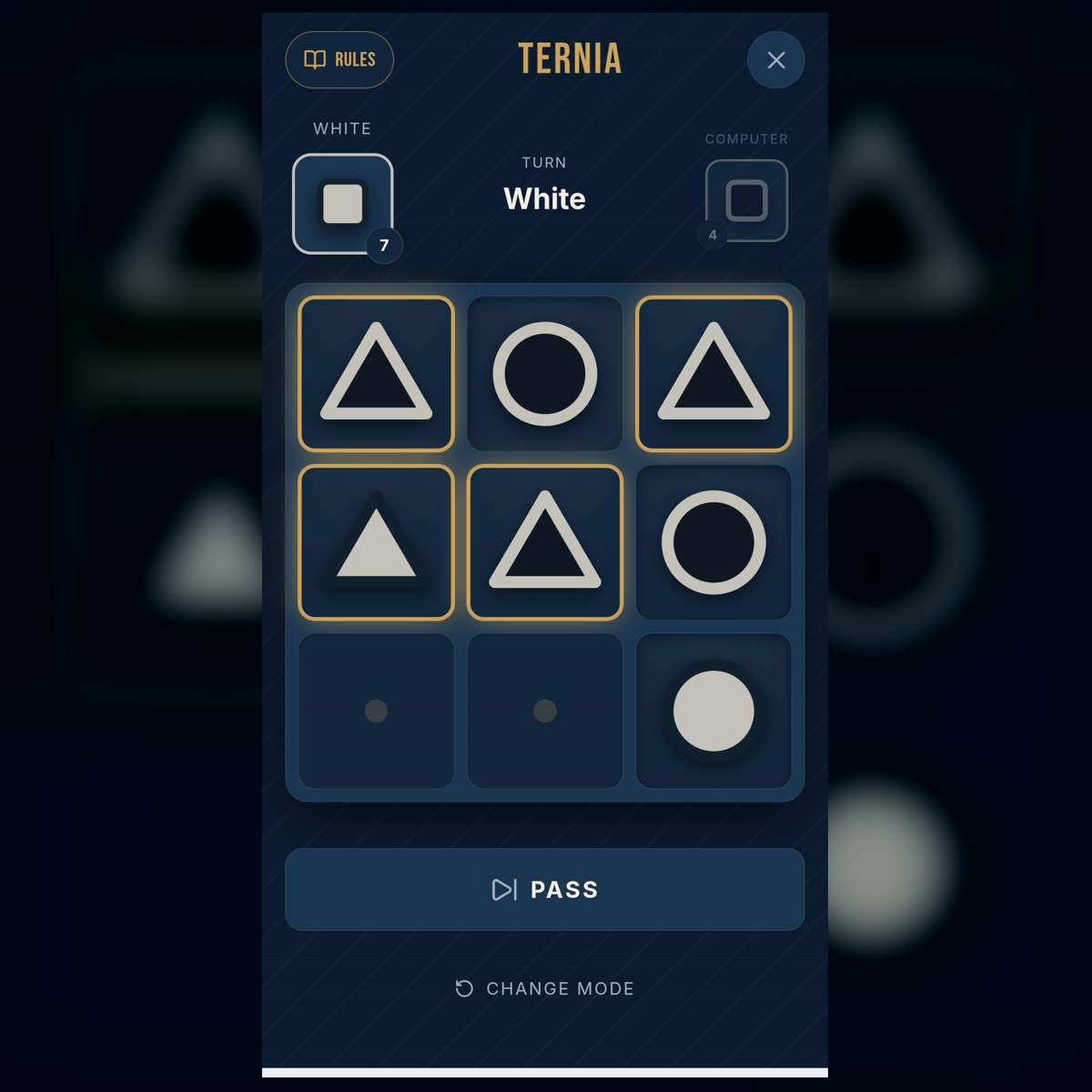
Ternia is an abstract strategy game on a 3×3 board. Each player has 9 tokens: three circles, triangles and squares of their colour. Goal: be the first to form a line (row, column or diagonal) of three identical tokens of your colour. On your turn place the top token from your stack on an empty cell, or cover any other token — your own or your opponent's — by hierarchy: triangle beats circle, square beats triangle, circle beats square. A covered token returns to its owner. Instead of a move you may "Pass".
"Ternia" is an abstract strategy game for two players where a familiar 3×3 grid becomes a space for multi-layered planning. Each player has nine pieces: three circles, three triangles, and three squares. The objective seems simple — form a straight line of three matching pieces of your own color. However, pieces can be covered, returned to their owner, and reintroduced into play, making the board state constantly evolve and meaning that the obvious move is not always the best one.
The game can be viewed as a much deeper version of tic-tac-toe. Occupying the right spaces is not enough: it is crucial to choose the correct piece type, foresee potential covers, and keep in mind which piece will remain beneath the top layer.
How the Hierarchy Cycle Works
In "Ternia," there is no ultimate piece that defeats all others. Hierarchy forms a closed loop:
a triangle covers a circle;
a square covers a triangle;
a circle covers a square.
This principle resembles the mechanics of "rock-paper-scissors." Each piece is strong against one type and vulnerable to another. Because of this, the strength of a move depends not only on the piece itself, but also on the overall board state, the opponent's available pieces, and possible responses on subsequent turns.
When a piece is covered, it is not eliminated from the game forever; instead, it returns to its owner. This is a key feature: an aggressive move can simultaneously disrupt an opponent's combination and return a valuable resource to them. Therefore, covering a piece does not always yield an absolute advantage. Sometimes it is better to leave an opponent's piece on the board if it occupies an inconvenient space for them or blocks their use of another piece.
Strategic Thinking on a Small Grid
A 3×3 grid is easy to view all at once, but the small number of spaces makes every decision uniquely critical. In larger strategy games, a mistake can sometimes be offset in another area of the board. In "Ternia," nearly every space directly impacts multiple potential lines.
The center space belongs to four lines: horizontal, vertical, and two diagonals. A corner space participates in three lines, while an edge space participates in only two. This makes the center immensely influential, but it does not mean it must be claimed at any cost. A piece in the center becomes an obvious target for being covered, and an ill-chosen piece type may grant the opponent an opportunity to reshape the position to their benefit.
A player must constantly manage several tasks simultaneously:
building their own line;
preventing the opponent from completing their combination;
preserving pieces capable of covering potential threats;
controlling spaces that belong to multiple lines;
anticipating which piece will be revealed after a potential cover.
It is the interplay of these tasks that creates strategic depth. A move that advances one combination may weaken another or consume the only piece required for future defense.
Planning Several Moves Ahead
In its simplest form, a player evaluates only the immediate state: where a line can be formed and which threat must be blocked. Deeper play begins when analysis extends across multiple potential moves.
Before placing a piece, it is helpful to ask three questions:
What threat am I creating with my next move?
Which piece can my opponent use to respond?
What will remain on the board or return to the reserve after a cover?
Double threats are particularly dangerous — positions where a player can complete one of two different lines. Blocking both with a single standard move is often impossible. Therefore, it is essential not only to react to existing pairs of identical pieces, but also to recognize setups that can turn into double pressure.
At the same time, not every threat demands an immediate answer. Sometimes an opponent appears to approach a line, but lacks the necessary piece in reserve, or their piece can be easily covered. The ability to distinguish genuine danger from false threats prevents wasted turns on unnecessary defense.
Hidden Information and Memory
Covered pieces remain part of the board position, even though they are no longer visible. For this reason, players must remember what lies beneath the top layer. If the top piece is later covered or removed according to game mechanics, the underlying element can affect a line once again.
Memory in "Ternia" does not work in isolation; it functions alongside strategic analysis. It is not enough simply to recall that a triangle lies beneath a square. You must determine who owns it, which line it could restore, and whether that outcome is beneficial after the next sequence of moves.
Beginners can use a simple technique: after every cover, mentally state the contents of the space, such as "my circle is under their triangle." This short verbal cue aids memory. With experience, the board is no longer viewed as nine separate spaces, but as an interconnected system of layers and threats.
Why the Pass Option Exists
The option to pass a turn adds another layer of decision-making. In most board games, passing is viewed as a loss of tempo, but in "Ternia," it can be a deliberate strategic choice.
Sometimes any available placement worsens your position: opening a space for a favorable cover, expending a critical defensive piece, or disturbing a balance where the opponent is forced to act first. In such scenarios, passing allows you to avoid making a weak move simply because a move is available.
However, overly cautious play is also dangerous. Passing without a specific reason surrenders the initiative. A pass should be used when you clearly understand why altering the board state right now benefits your opponent more than it benefits you.
Practical Strategies for Early Games
Do not rush to build an obvious pair immediately. Two identical pieces in a single line create a threat, but they also reveal your plan to the opponent. Sometimes it is more advantageous to place identical pieces so that they contribute to multiple potential lines.
Control piece types, not just spaces. If an opponent has used all pieces of a certain type, some of your elements may temporarily become safer. However, returning a covered piece to their reserve can suddenly shift this balance.
Before covering a piece, check what you are returning to your opponent. Eliminating a threat might be correct, but the returned piece could immediately create a new danger elsewhere.
Keep an eye on the center, but do not make it your sole focus. Controlling the center opens many lines, but victory is often prepared through interaction between the center and the corners.
Calculate not only your next move, but also your opponent's strongest response. It is helpful to imagine swapping sides after your decision and searching for the most uncomfortable reply.
Do not expend all pieces of one type too early. A varied reserve offers more options for covering and defending.
What Skills "Ternia" Develops
The game engages strategic thinking because every decision must be evaluated not in isolation, but as part of a sequence of potential responses. A player forms a plan, tests it for vulnerabilities, and adapts it following the opponent's actions.
Cognitive flexibility is required to constantly re-evaluate plans. A line that seemed promising can lose its value after a single cover. Instead of mechanically pushing a failed plan, players must quickly pivot to a new axis of attack or transition to defense.
Attention is needed to monitor all potential lines, available covers, and reserve pieces. Due to the cyclic hierarchy, identifying a threat is not enough — you must also determine precisely which piece type can neutralize it.
Working and visual-spatial memory help retain information about covered elements, previous moves, and remaining resources for both players. This is not a rote memory exercise: information must be actively applied to project future board states.
Risk assessment arises when choosing between attacking, defending, covering, and passing. Players weigh immediate gains against potential consequences, learning that a move that appears strong at first glance may carry a hidden cost.
Who Might Enjoy This Game
"Ternia" is ideal for players who appreciate short abstract games with zero randomness and simple rules. The core mechanics are easy to grasp, yet playing well requires reading board layers, managing reserves, and anticipating opponent responses.
The game works well as a quick mental warmup when looking to switch from routine tasks to a challenge that demands focus and planning. It is also suitable for adults and children to play together, provided players understand the cyclic advantage rule and can track multiple conditions simultaneously.
Parties can also use the game to analyze their own playing style. Some players attack relentlessly, others defend for too long, while some cover pieces compulsively without considering what they return to the opponent. Observing these habits fosters more mindful play.
From Tic-Tac-Toe to Modern Abstract Strategies
3×3 grid games naturally recall tic-tac-toe — one of the best-known positional games. Its rules are exceptionally simple, but with optimal play, the game always ends in a draw. For this reason, modern abstract game designers often add new layers of interaction to the familiar grid: pieces of varying strength, movement, covering, hidden elements, or alternative win conditions.
"Ternia" expands this concept using three piece types and cyclic hierarchy. As a result, the same space can change strategic value multiple times, and claiming a position is never permanent. Players fight not only for geometric lines, but also for control over which pieces remain available and which elements are hidden beneath others.
Cyclic advantage systems are frequently used in game design because they prevent the existence of a single dominant choice. When every piece has both a strength and a weakness, decisions depend on context. This maintains game variety and forces players to analyze their opponent rather than repeat a single static pattern.
How to Improve at "Ternia"
After completing a game, it is helpful to review one or two key moments to identify where the board state shifted most significantly. You do not need to analyze every turn. Simply find the first decision that forced you into continuous defense or cost you the opportunity to create your own threat.
It is also useful to play games with different focus areas. In one game, focus on center control; in another, on creating double threats; in a third, on tracking all reserve pieces carefully. This approach helps you see the mechanics from multiple angles without anchoring to a single template.
The most important skill in "Ternia" is not finding a single flashy move, but understanding how a move alters the options available to both players. Nine spaces are more than enough to create a game about initiative, hidden information, risk, and constant re-evaluation.