
Home › Brain trainers › Fog
Fogvisual memory game
Memorize the board, then clear the fog over the target number with gusts of wind. Trains memory and reaction.
Play now →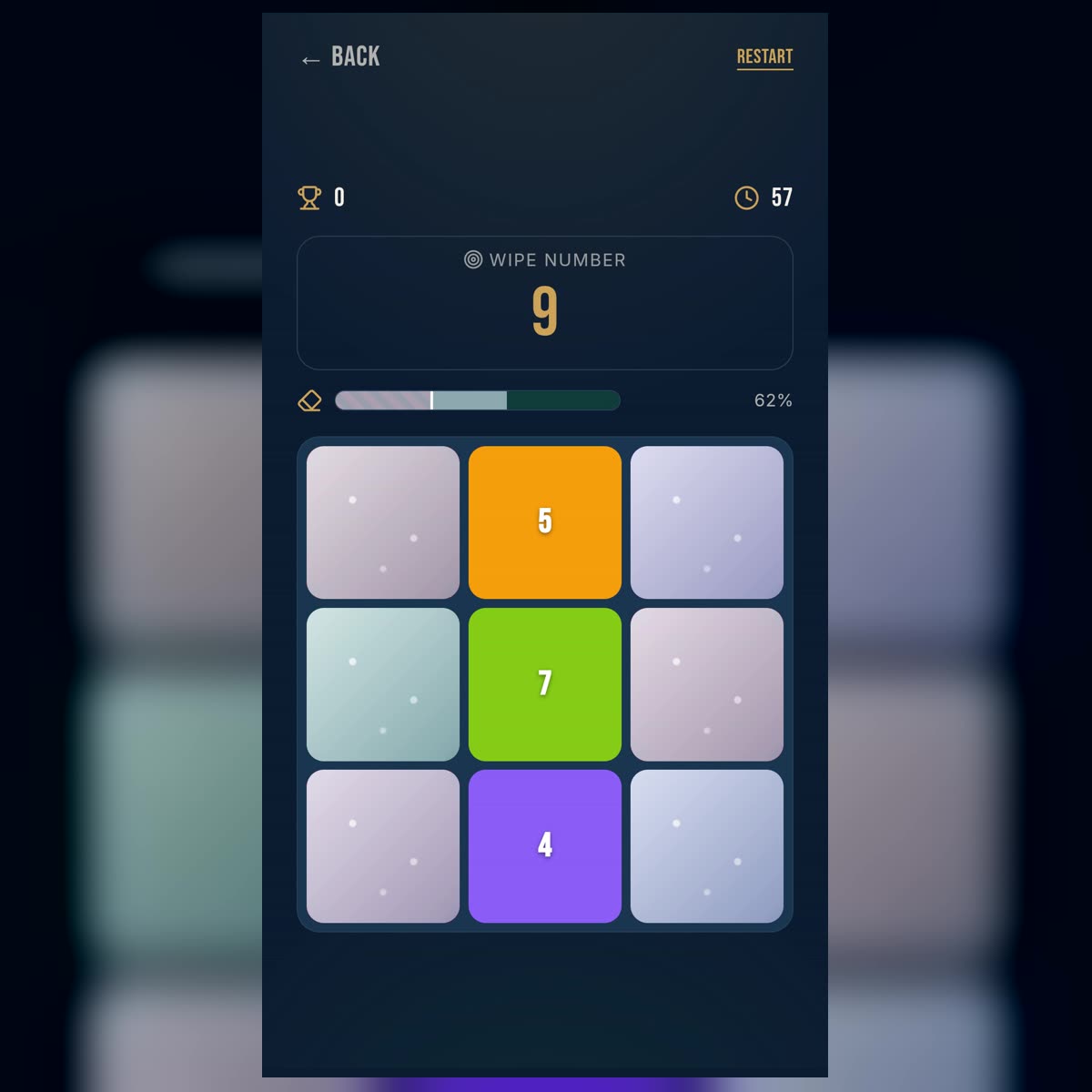
The Fog simulator is an exciting memory game that tests your ability to navigate blindly. First, you are shown a playing field for a few seconds, where various numbers are arranged in a specific order. Your task is to remember their location as accurately as possible. As soon as the time is up, the screen seems to fog up heavily, hiding all objects from view. After that, the system asks you to find a specific number, and you need to "wipe" the screen from memory exactly in the place where it was hidden.
WHAT IT DEVELOPS AND WHY EXACTLY
This exercise is a powerful tool for training visual-spatial memory, concentration, and the speed of visual information processing. When the field is covered with fog, you can no longer rely on external stimuli. Your brain is forced to refer exclusively to the internal, mental image of the screen that it managed to form in a matter of seconds. From a scientific point of view, such a process actively stimulates the hippocampus — the brain area responsible for spatial navigation and the consolidation of short-term memory. You don't just remember what exactly was on the screen, you firmly fix the coordinates — where the object was located relative to other elements. In addition, the need to act quickly further trains the ability to instantly extract information from memory under time pressure.
HOW TO PLAY AND STRATEGY
The biggest mistake beginners make in this simulator is trying to remember each number separately, randomly darting their eyes across the field. The capacity of our short-term memory is limited, so such tactics quickly lead to failure. The best strategy is to use the grouping technique known in cognitive psychology (chunking). Try to remember the location of numbers in whole rows, geometric shapes, or small clusters of three or four elements. For example, you can visualize that the largest numbers formed a triangle in the left corner. This significantly reduces the load on memory.
WHO AND WHEN IT IS USEFUL FOR
This simulator is ideal for people who find it difficult to keep many spatial details in their heads, or those who often forget where they put things. It is an excellent daily warm-up for improving spatial orientation skills and the ability to quickly reproduce a seen picture from memory without external cues.