Home › Brain trainers › Chess Tactics
Chess Tacticstimed chess puzzles
Find the best move: mates, forks, pins. 10 positions against the clock, from easier to harder.
Play now →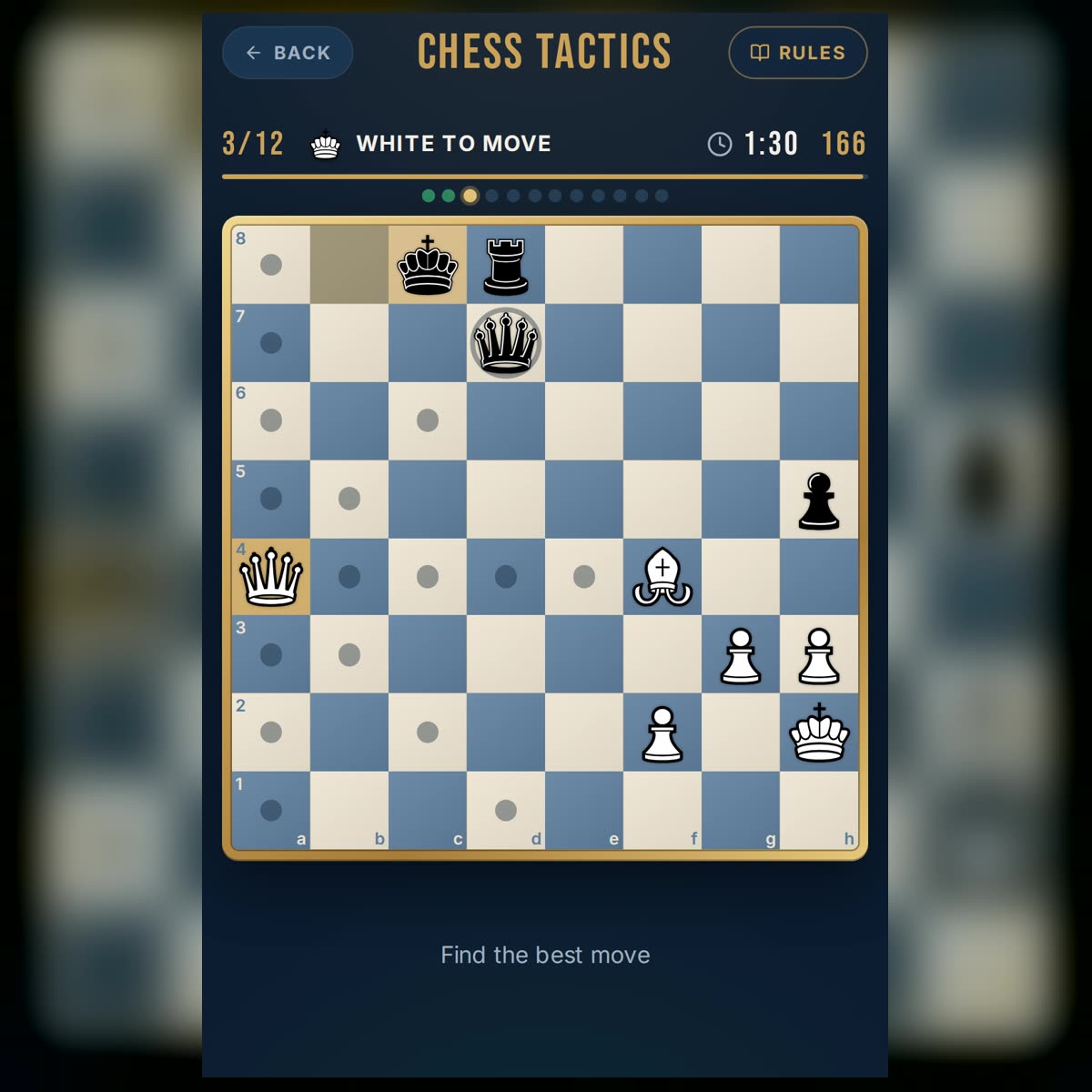
A chess tactics puzzle is a position from a real game in which one side has a forced win: a checkmate or a gain of material. The task is to find the move after which nothing can save the opponent.
The puzzles in BB Gym come from the open Lichess database. The positions are taken from games played on Lichess, and every solution has been checked by a chess engine. Each puzzle has a rating that depends on how players cope with it: the higher the rating, the harder the puzzle.
How the game works
A session has 10 positions. The position appears, your opponent makes a move, and then it is your turn. Next to the board you see whose move it is, the puzzle number and the clock.
There are three levels. Easy: puzzles rated 400–1000, with 90 seconds for each. Medium: 1000–1500 and 120 seconds. Hard: 1500–2000 and 150 seconds. Within a session the puzzles go from easier to harder.
You can play all themes mixed or pick one: mate in 1, mate in 2, fork, pin, skewer, hanging piece, discovered attack or back-rank mate.
You get one attempt. A wrong move ends the puzzle, and the game shows the correct solution. If a puzzle has several moves, the opponent replies on its own and you carry on. Any checkmate counts, even if the database lists a different move.
You can drag a piece, or tap it and then tap the square it should go to. A pawn that reaches the last rank promotes to the piece you choose.
How the score works
A session is worth up to 1000 points, and every puzzle carries the same share. Two thirds of that share are for a correct solution and the rest is for speed. A puzzle solved in the last second is worth more than any time saved on another one, so rushing into a mistake does not pay.
After the session you can open each puzzle again and look at the position, your move and the correct solution.
The main tactical motifs
Fork: one move attacks two pieces at once, and the opponent can save only one of them. Knights are best known for forks, but pawns, queens and even the king fork too.
Pin: a piece cannot leave a line because a more valuable piece or the king stands behind it. If the king is behind it, the rules do not allow the pinned piece to move at all.
A skewer is a pin the other way round. A valuable piece is attacked, and when it steps aside, the less valuable piece behind it on the same line is lost.
A hanging piece is one that nothing defends and that can simply be taken. These puzzles train the habit of checking whether the opponent has left something unprotected.
Discovered attack: a piece moves away and opens a line for another piece standing behind it. If the line leads to the king, it is a discovered check. The opponent has to save the king first, and meanwhile the piece that moved can attack anything it likes.
A back-rank mate is given to a king hiding behind its own pawns. A rook or queen comes to the first or eighth rank, and the king has no square to escape to.
In mate-in-1 and mate-in-2 puzzles the goal is checkmate, not material. In a two-move puzzle the first move is often quiet or a sacrifice: it gives no check, but after it the opponent can no longer stop the mate.
How to look for the move
Coaches suggest starting with forcing moves: checks, captures and direct threats. They leave the opponent the fewest replies, so they are the easiest to calculate to the end.
Look at which enemy pieces are undefended and where the enemy king stands. The opponent's move that starts the puzzle is a hint too: it has often weakened something.
Before you move, find the opponent's strongest reply. A spectacular move that lets the opponent escape does not solve the puzzle.
You have one attempt, so time is better spent checking than guessing quickly. Speed gives only a third of the points for a puzzle.
What research says
The Dutch psychologist and chess master Adriaan de Groot asked players of different strength to think aloud about a position and published the results in 1946. Grandmasters did not consider many more moves than strong club players. The difference was in which moves came to mind: the stronger players more often saw the right ones straight away.
In 1973 William Chase and Herbert Simon showed chess players a position for five seconds and asked them to reconstruct it. The master recalled positions from real games far more accurately than the beginner, but with randomly placed pieces this advantage almost disappeared. An experienced player remembers not separate pieces but familiar groups of pieces and the relations between them. This is why coaches give students many tactics puzzles: a familiar motif is recognised faster than it could be calculated.
Whether chess makes people smarter in general is a different question. A 2016 meta-analysis by Giovanni Sala and Fernand Gobet pooled studies of chess lessons in schools and found a moderate effect on mathematics and reading, but most of those studies were weakly designed. In 2017 the same authors compared chess, music and working memory training: the more carefully a study was designed, the smaller the effect it found. Their conclusion was that skills rarely transfer to tasks far from the ones that were trained.
Another 2016 meta-analysis found that chess skill is positively related to cognitive ability. Such data, however, do not show which is the cause and which is the effect. So the honest way to see these puzzles is as practice in chess tactics. Results in BB Gym are not a psychological assessment.
Who it is for
The Easy level is for anyone who knows how the pieces move and wants to learn to spot simple tactics. On Medium and Hard the puzzles are longer and the motifs combine: a fork after a sacrifice, a mate after a discovered check.
A coach can give students a link to a fixed set of puzzles. Then everyone solves the same positions, and the results are easy to compare.
Sources
- Lichess puzzle database (CC0)
- A. D. de Groot. Thought and Choice in Chess. 2nd ed., 1978
- W. G. Chase, H. A. Simon. Perception in chess. Cognitive Psychology, 4(1), 55–81, 1973
- G. Sala, F. Gobet. Do the benefits of chess instruction transfer to academic and cognitive skills? A meta-analysis. Educational Research Review, 18, 46–57, 2016
- G. Sala, F. Gobet. Does far transfer exist? Negative evidence from chess, music, and working memory training. Current Directions in Psychological Science, 26(6), 515–520, 2017
- A. P. Burgoyne et al. The relationship between cognitive ability and chess skill: A comprehensive meta-analysis. Intelligence, 59, 72–83, 2016