
Home › Brain trainers › Sumosaic
Sumosaicnumber mosaic puzzle
A square of numbers has been cut into pieces. Put it back together so that every row and column adds up to the same sum.
Play now →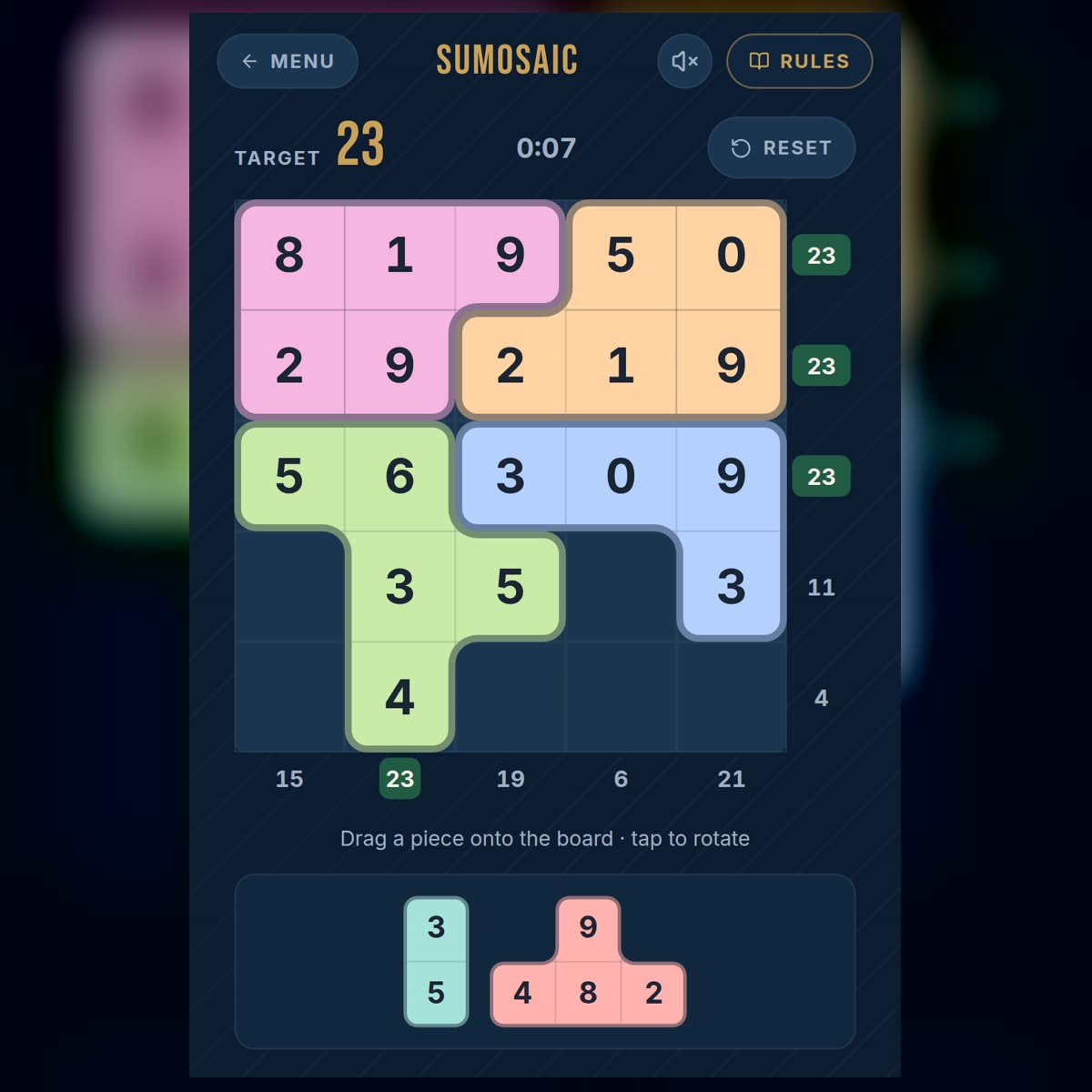
Sumosaic is a number puzzle in which you build a square out of pieces. It started as a whole square of numbers in which every row and every column has the same sum. That square was cut into coloured pieces of one to five cells, and your task is to put them back together so that all the sums match again.
The game makes you think along two lines at once. The first is geometric: will this piece fit here, and which way should it be turned? The second is arithmetic: how much is this row still missing, and will the column go over? The solution appears where both answers agree.
The rules in a minute
The target is shown above the board: the number that every row and every column must add up to. The numbered pieces sit below the board. Drag a piece onto the board to place it; tap it to rotate it a quarter turn. Pieces can’t be flipped, only rotated.
You can drag a piece from the board back to the tray at any time. The square is complete when the board is full and every sum equals the target. Any such arrangement counts, not only the one the puzzle was cut from.
How to read the sums around the board
To the right of each row and below each column you can see the current sum of the numbers already placed there. A grey sum means the line isn’t full yet. Green means the line is full and equals the target. Red means the sum is already larger than the target: something in that line doesn’t belong, and it can no longer be completed.
It is more useful to look not at the sum itself but at the gap to the target. If the target is 20, a row already has 16 and one cell is empty, only a 4 can go there. These bottlenecks tell you which piece to place and which way round.
Where the puzzle comes from
Mathematicians call a square in which all rows and columns have the same sum semi-magic. If both diagonals give the same sum as well, the square becomes magic. Unlike in a classic magic square, numbers can repeat here.
Each time, the game builds a new square of this kind, cuts it into pieces and then hands them out in random order and orientation. The puzzle can always be solved, because the original arrangement exists. Sometimes, though, another correct arrangement exists too, and then it counts as well.
Modes and levels
The difficulty determines what the numbers can be. On Base they are digits from 0 to 9, on Pro numbers up to 19, and on Elite numbers up to 29. The bigger the numbers, the bigger the sums you have to keep in your head. The board size is chosen separately: 4×4, 5×5 or 6×6.
Two more toggles change the puzzle itself. “Diagonals” requires both diagonals to reach the target too; they are highlighted on the board, and their sums are shown below it. “Anchor number” puts one number in its place before the game starts. It isn’t part of any piece and gives you a point to work from.
Common mistakes
Placing a piece wherever it simply fits. The shape is right, but the numbers push a neighbouring column over the target, and the mistake only shows up a few moves later.
Counting only the rows. Every cell belongs to both a row and a column, so a piece that completes a row can spoil two or three columns.
Forgetting about rotation. A piece that “doesn’t fit” often fits after one or two turns: its numbers stay the same, but they land in different lines.
Practical tips
Start with the big pieces. A five-cell piece has few places where it can go, so its position is settled sooner. Small pieces are handier to leave for the end, when you use them to fill the gaps.
Look for corners and edges. A piece with a bump rarely fits into a corner whichever way it is turned, and that narrows the choice.
When a line has one or two empty cells left, work out how much it is missing and look for a piece with the right number on exactly that side. If you reach a dead end, the Reset button returns all the pieces to the tray.
Score
The score for a completed square depends on the board size, the difficulty and the Diagonals mode. The anchor number makes the puzzle easier, so it slightly reduces the score. Speed adds a bonus of up to half the score on top. Each completed square is saved separately, so you can play a series of puzzles in a row.